
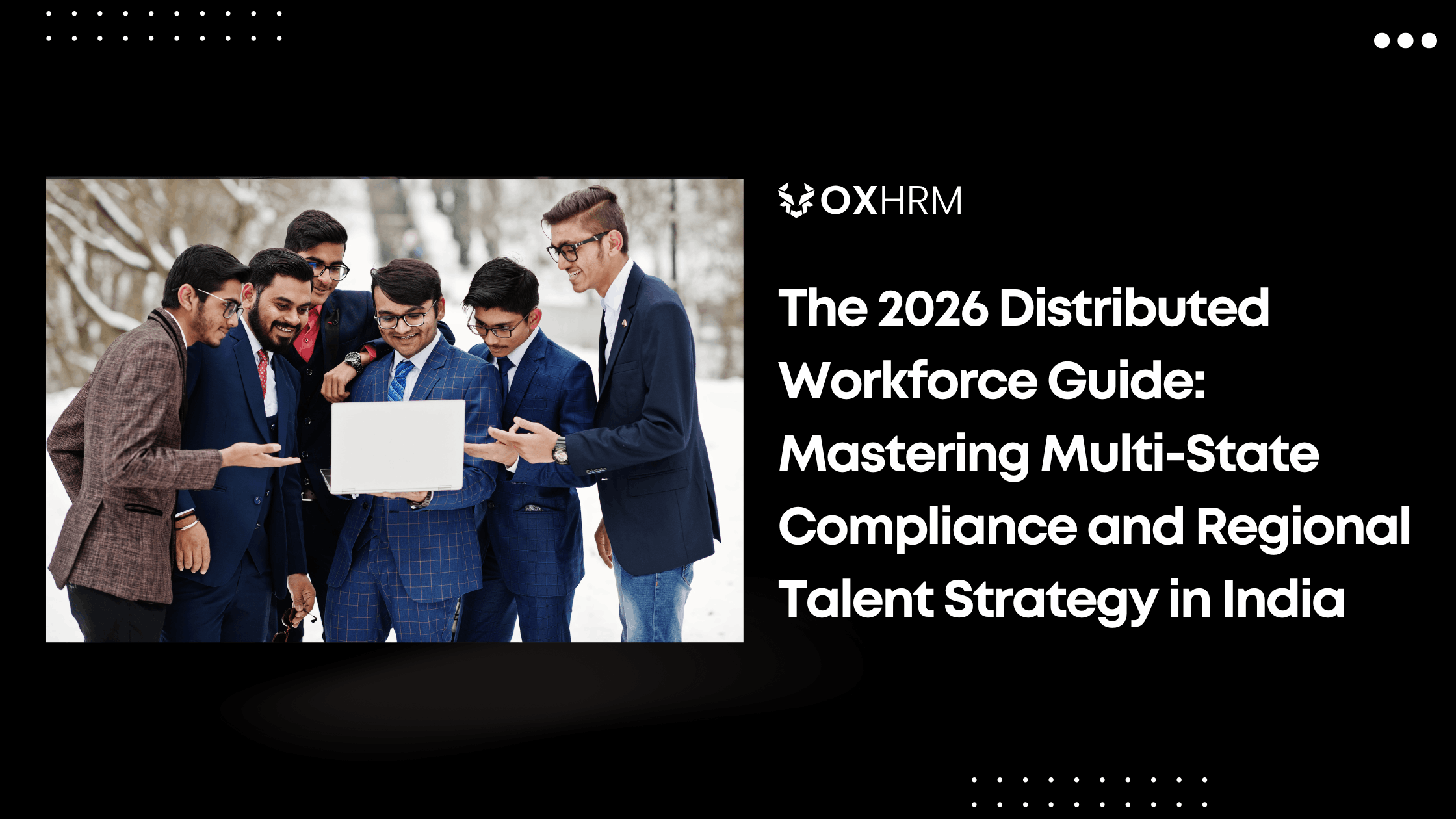
The 2026 Distributed Workforce Guide: Mastering Multi-State Compliance and Regional Talent Strategy in India
In 2024, “Remote Work” was an experiment. By 2025, it was a debate. But as we navigate 2026, distributed work has become the foundational architecture of the Indian economy. The “Great Reverse Migration”—the movement of high-skilled talent from saturated metros like Bengaluru and Mumbai back to Tier-2 and Tier-3 cities—has fundamentally redrawn the map of talent acquisition.
However, for HR departments, this geographic freedom has come with a massive “Complexity Tax.” Managing an employee in Jaipur is legally, financially, and culturally different from managing an employee in Chennai. From varying Professional Tax (PT) slabs to the nuances of state-specific Labor Welfare Funds (LWF), the “Work-from-Anywhere” dream can quickly become a “Compliance Nightmare.”
This guide is the definitive manual for HR leaders to master the 2026 Distributed Workforce. We will dive into the legalities of multi-state operations, the restructuring of regionalized benefits, and the technological infrastructure required to turn a fragmented team into a unified powerhouse.
1. The New Geography of Talent: The Rise of the “Regional Hub”
In 2026, the concept of a “Head Office” has been replaced by the “Hub-and-Spoke” model. Companies are no longer forcing 1,000 people into one building in HSR Layout; they are supporting 50 people in a hub in Indore, 30 in Coimbatore, and 500 working from their homes across 20 different states.
Why Tier-2 is the New Tier-1:
-
Lower Operating Costs: Real estate and utility costs in Tier-2 cities are 40-60% lower than in Tier-1 metros.
-
Higher Retention: Employees working from their hometowns report a 25% higher “Life Satisfaction Score” and significantly lower “Intent to Leave.”
-
The “Reverse Brain Drain”: Top-tier talent is now prioritizing “Quality of Life” over “Office Address,” meaning the best engineers are often found in cities once considered “secondary.”
2. The Compliance Labyrinth: PT, LWF, and S&E Acts
When your workforce is spread across 28 states and 8 union territories, your “Compliance Surface Area” expands exponentially. In 2026, the Indian government has digitized its enforcement, making “accidental non-compliance” a costly mistake.
A. Professional Tax (PT) Fragmentation
Professional Tax is a state-levied tax on professions and trades. The problem? Every state has its own slabs, its own filing deadlines, and its own definition of “Taxable Income.”
-
The 2026 Complexity: If an employee moves from Maharashtra (where PT is capped at ₹2,500/year) to Karnataka, their deduction schedule changes. If they move to Delhi (which has no PT), it stops entirely.
-
The Risk: Failing to register the company in the employee’s state of residence while deducting PT is a major audit red flag.
B. Labor Welfare Fund (LWF) Nuances
LWF is a state-specific social security fund. In states like Tamil Nadu, Gujarat, and Haryana, both the employer and employee must contribute.
-
The “Half-Yearly” Headache: Some states require monthly filings, others half-yearly. In 2026, many states have synchronized their LWF with the New Wage Code, adding another layer of calculation complexity.
C. The Shop and Establishment (S&E) Act 2026
The most critical legal hurdle for a distributed team is the S&E Registration.
-
The Remote Work Clause: Under the 2026 S&E amendments in several states, if you have more than 5 employees working from a specific city (even if they work from home), that city can be classified as a “Deemed Branch,” requiring local registration and adherence to local holiday calendars and working hour restrictions.
3. Payroll Precision: The “Dual-Location” Challenge
Under the New Wage Code 2026, the “Place of Work” determines which state laws apply to the employment contract. This creates a “Dual-Location” challenge for payroll.
The “Base” vs. “Physical” Location
If your company is registered in Gurgaon but the employee is working from Kochi:
-
Which Holiday List applies? (Onam is a public holiday in Kerala, but not in Haryana).
-
Which Overtime rules apply? (State-specific S&E Acts define overtime differently).
-
Which Wage Floor applies? (Minimum wages vary significantly by state).
OXHRM’s Solution: Our payroll engine uses Dynamic Location Logic. The system automatically detects the employee’s “Physical Work State” and overlays the correct S&E rules, PT slabs, and LWF requirements onto their monthly salary slip, ensuring 100% compliance without manual intervention.
4. Regionalized EVP: Benefits That Matter in 2026
The Employee Value Proposition (EVP) that works for a high-flying bachelor in Mumbai does not resonate with a family-oriented professional in Lucknow. In 2026, “Superworkers” expect Contextual Benefits.
Tier-2 Benefit Strategies:
-
The “Co-working Credit”: Instead of a central office, provide a stipend for local co-working spaces. This provides the “Social Aspect” of work without the “Commute Stress.”
-
Localized Wellness: Partner with regional hospital chains and fitness centers. A gym membership in South Delhi is useless to an employee in Bhopal.
-
Cost-of-Living Adjustments (COLA) vs. Value-of-Skill: A major debate in 2026 is whether to pay based on “Location” or “Skill.”
-
The OXHRM Recommendation: Move toward a “Skill-First Pay Scale” with a “Location-Based Allowance.” This ensures equity across the team while acknowledging the different living costs of various regions.
-
5. Digital Employee Experience (DEX) for Distributed Teams
In 2026, the “Digital Employee Experience” (DEX) is the only experience remote employees have of your company. If your portal is slow, your communication is fragmented, or your IT support is non-existent, your culture will erode.
The Three Pillars of DEX 2.0:
-
Asynchronous Rituals: Move away from “Zoom Fatigue.” Use voice notes, video snippets, and collaborative docs. In 2026, the “Meeting that could have been an email” is considered a failure of leadership.
-
The “Single Pane of Glass”: Employees should be able to manage their entire lifecycle—from viewing their Skills Inventory to claiming EWA (Earned Wage Access)—from a single mobile app.
-
Virtual Social Capital: In a distributed world, “Watercooler Moments” must be engineered. Use AI-driven “Coffee Matches” (like those integrated into OXHRM) to pair employees from different regions for 15-minute informal chats.
6. The “Hub-and-Spoke” Model: Infrastructure of 2027
As we look toward 2027, the distributed model is evolving into the “Micro-Hub” strategy.
Instead of letting employees work from their dining tables indefinitely, companies are leasing small, 10-20 person “pods” in co-working spaces in Tier-2 cities.
-
The Benefit: It provides a professional environment and a consistent “Brand Experience” while maintaining the geographic flexibility employees crave.
-
The Management Challenge: How do you track attendance across 50 pods?
-
The Solution: Geofenced Attendance 2.0. OXHRM allows you to set up “Multi-Geofence Zones.” An employee can clock in at any “Official Pod” or their “Verified Home Location,” with the data flowing into a central dashboard for the HR manager.
-
7. Data Sovereignty and the DPDP Act in a Remote Setting
The DPDP Act 2026 is particularly strict about “Data in Transit.” When an employee works from home in a different state, your data security perimeter extends into their living room.
The Distributed Security Checklist:
-
Secure Access: Ensure all HR interactions (payslips, tax docs) are handled within a SOC-2 Type II compliant environment like OXHRM, rather than sent over insecure email or WhatsApp.
-
Consent for Monitoring: As discussed in our Ethical Monitoring guide, if you use “Idle Time” or “Screenshot” tracking for remote workers, you must have explicit, state-compliant consent forms on file.
-
The “Hard Wipe” Protocol: If a remote employee is terminated, you must be able to “Remote Wipe” access to all HR and company data instantly to prevent a data breach under the DPDP Act.
8. Why OXHRM is the Operating System for Distributed India
At OXHRM, we recognized the “Regionalization of Talent” years ago. Our platform is built specifically to handle the “Chaos of Choice” that comes with a distributed workforce.
-
Universal Statutory Engine: We maintain a database of PT, LWF, and Minimum Wage rules for every state and union territory in India, updated in real-time as laws change.
-
Multi-Calendar Support: Assign different “Holiday Groups” to different employees based on their state of residence. No more Kerala employees being forced to work on Onam because the head office is in Delhi.
-
Remote Onboarding 3.0: From digital document verification (DigiLocker integrated) to “Welcome Kits” triggered by courier APIs, we make Day 1 feel special, even if it’s 2,000 miles away from the manager.
-
Regional Language Support: In 2026, inclusivity means language. OXHRM’s mobile app supports major regional languages, allowing your frontline workers in every corner of India to access their HR data in the language they are most comfortable with.
9. Conclusion: The Borderless Enterprise
The organizations that will win in the late 2020s are those that stop viewing a distributed workforce as a “Challenge to be Managed” and start viewing it as a “Competitive Advantage to be Leveraged.”
By moving to a Tier-2 talent strategy, you aren’t just saving on rent; you are accessing a wider, more diverse, and more loyal talent pool. You are building an organization that is resilient to regional shocks and aligned with the “New Indian Dream” of working from where you live, rather than living where you work.
The transition requires a “Compliance-First” mindset and an “Experience-First” heart. With the right strategy and a unified platform like OXHRM, you can build a borderless enterprise that is ready for 2027 and beyond.
The 2026 Distributed HR Checklist
-
[ ] Audit: Do we have S&E registrations for every state where we have $>5$ employees?
-
[ ] Payroll: Is our PT/LWF calculation automated based on “Physical Location”?
-
[ ] EVP: Have we restructured our benefits to include “Co-working Stipends” or “Regional Wellness”?
-
[ ] DEX: Is our HR portal 100% mobile-accessible with regional language support?
-
[ ] Security: Is all remote-work data handling compliant with the DPDP Act 2026?
Table of Contents

Shafeeq Khan is a web developer who creates modern, responsive, and user-friendly websites with clean code and creative design
Latest Posts
The 2031 Existential HR Guide: Managing the Psychological Transition to a Work-Optional World
Welcome to 2031. The decade-long transition that began with the "Great Resignation" and the "AI Revolution" has culminated in a...


The Rise of the Fractional C-Suite: Orchestrating Elite Talent Across Multiple DAOs in the 2030 Contribution Era
By 2030, the traditional "Corner Office" has been auctioned off as a historical artifact. The corporate landscape is no longer...
The 2030 Global Labor Protocol: Navigating the End of National Payroll and the Rise of Algorithmic Compliance
Remember 2024? Remember the frantic scramble at the end of every fiscal quarter? The endless back-and-forth with tax consultants over...