
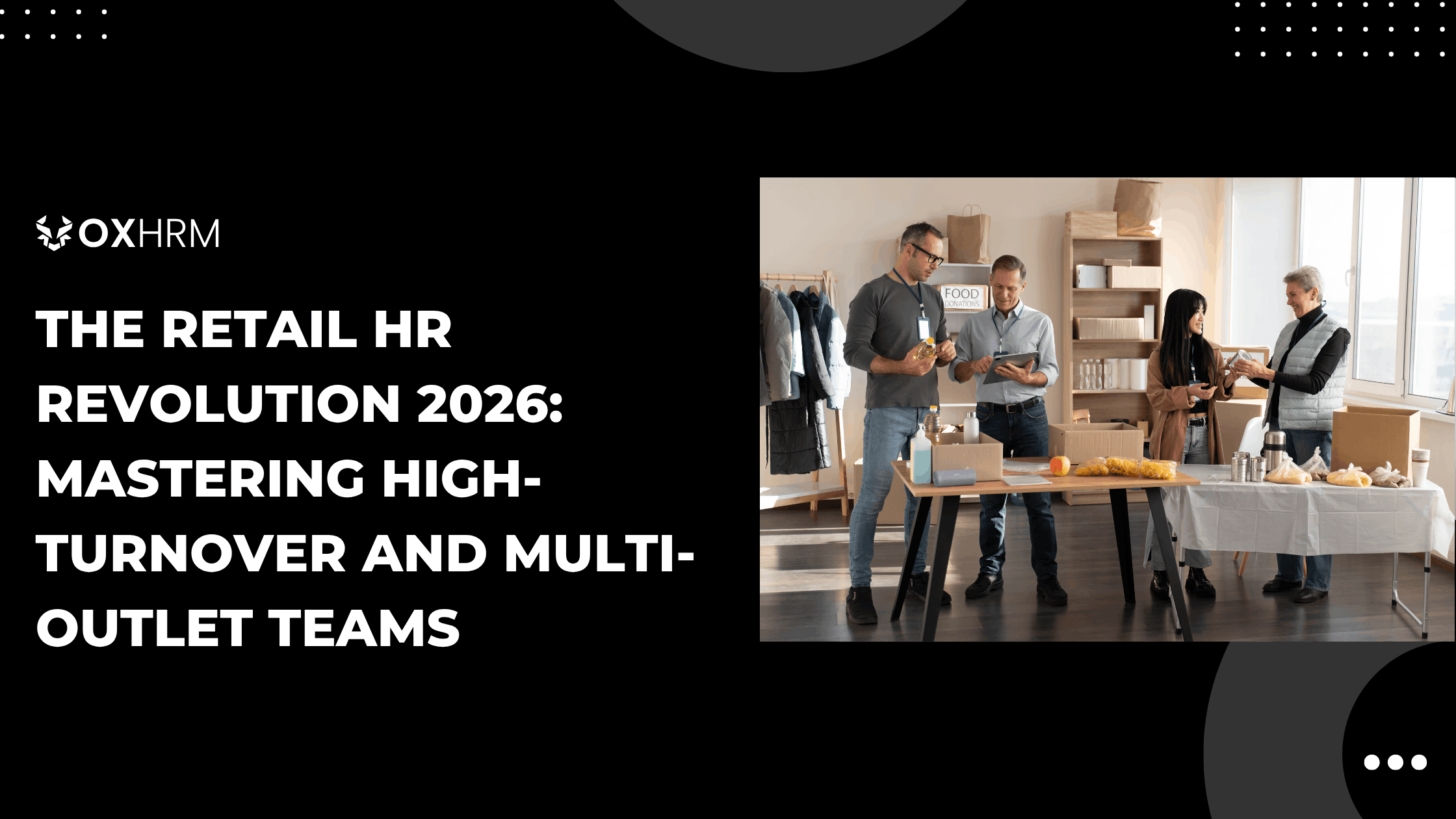
The Retail HR Revolution 2026: Mastering High-Turnover and Multi-Outlet Teams
In the Indian business landscape of 2026, the retail sector is no longer just about “selling products”—it is about “managing people at scale.” With the explosive growth of quick-commerce, organized retail, and multi-city F&B chains, the pressure on HR departments has reached a breaking point.
Retailers are facing a dual crisis: attrition rates that often exceed 60% annually and a regulatory environment (New Wage Code and DPDP Act) that demands surgical precision in payroll and data handling.
This guide serves as a strategic blueprint for retail owners and HR leaders to navigate the “Frontline Revolution” of 2026. We will explore how AI-driven orchestration, financial wellness tools, and hyper-local compliance are turning the tide for high-turnover teams.
1. The Real Cost of Turnover in 2026
In 2026, the cost of losing a single store associate isn’t just their salary. When you factor in the “Hidden Costs,” the impact on your EBITDA is staggering.
The Attrition Math:
-
Replacement Cost: Recruitment marketing + interviewing time.
-
Onboarding Lag: The 2-week period where a new hire is only 50% productive.
-
Lost Sales: Poor customer service from inexperienced staff leading to “cart abandonment” in physical stores.
-
Institutional Knowledge: Loss of customer relationships and store-specific operational nuances.
The 2026 Benchmark: Data suggests that replacing a retail employee earning ₹25,000/month actually costs the company approximately ₹1,20,000 when all factors are considered. For a chain with 50 outlets and 20% quarterly churn, this is a multi-crore leak in the balance sheet.
2. Predictive Scheduling: The End of the “Excel Shift”
The most common reason for frontline resignation in 2026 isn’t just “low pay”—it’s “schedule instability.” ### What is Predictive Scheduling? Using AI integrated into your HRMS (like OXHRM), managers can now forecast staffing needs based on:
-
Historical Sales Data: Scaling up staff for Diwali or weekend rushes.
-
Local Weather Patterns: Predicting footfall drops or delivery spikes during monsoon seasons.
-
Employee Preference: AI-matching shifts with employees who have shown a preference for morning vs. night shifts, reducing “no-shows.”
The “Fair Work” Trend
In 2026, “clopenings” (working a closing shift followed by an opening shift) are being phased out by ethical retailers. Predictive scheduling ensures a minimum 11-hour rest period between shifts, automatically flagged by the system to ensure compliance and prevent employee burnout.
3. Financial Wellness: Earned Wage Access (EWA)
The “Monthly Pay Cycle” is a relic of the past for the 2026 frontline workforce. In a world of instant UPI payments and high-speed commerce, workers expect their pay to be as liquid as their work.
Why EWA is a Retention Magnet
Earned Wage Access allows employees to withdraw a portion of their already earned salary before the official payday.
-
Reduced Financial Stress: Workers don’t have to turn to high-interest “predatory” payday lenders for emergency medical bills or school fees.
-
Increased Loyalty: Statistics show that companies offering EWA through their HRMS see a 25-30% drop in attrition.
-
Zero Impact on Cash Flow: Modern HRMS platforms like OXHRM partner with financial providers to fund these withdrawals, meaning the employer’s cash flow remains untouched until the standard payroll date.
4. Multi-Outlet Geofencing & The “Ghost Attendance” Problem
For a retail chain with 100 outlets across India, “Buddy Punching” (where one employee clocks in for another) was a major leakage point. In 2026, technology has effectively solved this.
Advanced Geofencing 2.0
Modern HRMS systems use Dynamic Geofencing. An employee can only clock in if their GPS coordinates are within a 50-meter radius of their assigned store.
-
Photo-Verification: The system requires a “Selfie-Check-in” which is matched against an AI-stored biometric profile.
-
Roaming Profiles: For area managers or “floaters” who move between stores, the HRMS automatically recognizes which “Zone” they are in and allocates their hours to the correct cost center.
5. Micro-Learning: Training in the “Flow of Work”
Long, classroom-style training sessions are dead. The 2026 retail employee learns in 30-second bursts.
The Mobile-First Training Model
Instead of a manual, new hires receive “Nudges” on their OXHRM app:
-
Morning Nudge: “Today’s special is the Hazelnut Latte. Here are the 3 key talking points.”
-
Compliance Nudge: “A new safety regulation regarding floor cleaning was passed. Watch this 15-second video to stay certified.”
-
Gamification: Employees earn “Badges” or “Points” for completing training, which can be redeemed for small rewards or priority shift selection.
6. The 2026 Compliance Landscape for Retailers
Managing a retail workforce in India in 2026 requires navigating three specific legal hurdles:
A. The New Wage Code (50% Rule)
As discussed in our previous guide, your store associates’ “Basic Pay” must be 50% of their CTC. For retail, where “Incentives” and “Bonuses” often make up a large chunk of pay, this restructuring is vital to avoid heavy PF/Gratuity penalties.
B. State-Specific Shop & Establishment Acts
In 2026, state governments have digitized their enforcement. Whether it’s the Karnataka Shops and Commercial Establishments Act or the Delhi Labour Rules, your HRMS must automatically adjust for different weekly off-rules and overtime calculations based on the store’s physical location.
C. The DPDP Act & CCTV Data
Retailers often use CCTV for security. However, under the 2026 DPDP Act, if you use that CCTV footage to monitor “Employee Performance” (e.g., counting how many customers a staff member approached), you must have explicit consent and follow strict data-retention policies.
7. Radical Transparency: The “Employee Self-Service” (ESS) Hub
In 2026, the “Frontline Experience” is the “Employee Experience.” If a worker has to call HR just to see their payslip or check their remaining leaves, they are more likely to quit.
OXHRM’s ESS Hub provides:
-
Instant Payslips: Downloadable in local languages.
-
Shift Bidding: Allowing employees to “claim” open shifts to earn extra income.
-
Grievance Redressal: A direct, anonymous channel to report store-level harassment or safety issues, bypassing the store manager if necessary.
8. Case Study: The 2026 Success Story
Imagine a mid-sized fashion chain with 40 outlets in Tier-2 Indian cities. Before OXHRM: They used WhatsApp for attendance and manual Excel for payroll. Turnover was 55%. Compliance was a “best effort” basis. After OXHRM: * Implemented AI Predictive Scheduling, reducing overtime costs by 18%.
-
Introduced Earned Wage Access, which became their #1 recruiting tool.
-
Turnover dropped to 32% within six months.
-
The HR Manager now spends 2 hours a week on payroll instead of 5 days.
9. Conclusion: The Competitive Edge of the “Happy Frontline”
In 2026, price wars and product quality are being neutralized by the internet. The last remaining competitive advantage in retail is the Human Interaction. A store staffed by well-paid, financially secure, and respected employees will always outperform a store run by “transient” workers who are just waiting for their next job. By utilizing a specialized HRMS like OXHRM, you are not just “managing headcount”—you are building a resilient, high-performance retail machine.
Retail HR Leader’s Checklist for 2026
-
[ ] Does your current HRMS support multi-outlet geofencing with photo-matching?
-
[ ] Have you restructured your retail salaries to meet the 50% Wage Code threshold?
-
[ ] Are you offering Earned Wage Access to compete with Quick-Commerce hiring?
-
[ ] Can your store managers generate a compliant shift roster in under 10 minutes?
-
[ ] Is your employee data (including CCTV monitoring) DPDP compliant?

Table of Contents

Shafeeq Khan is a web developer who creates modern, responsive, and user-friendly websites with clean code and creative design
Latest Posts

The 2031 Existential HR Guide: Managing the Psychological Transition to a Work-Optional World
Welcome to 2031. The decade-long transition that began with the "Great Resignation" and the "AI Revolution" has culminated in a...


The Rise of the Fractional C-Suite: Orchestrating Elite Talent Across Multiple DAOs in the 2030 Contribution Era
By 2030, the traditional "Corner Office" has been auctioned off as a historical artifact. The corporate landscape is no longer...
The 2030 Global Labor Protocol: Navigating the End of National Payroll and the Rise of Algorithmic Compliance
Remember 2024? Remember the frantic scramble at the end of every fiscal quarter? The endless back-and-forth with tax consultants over...