
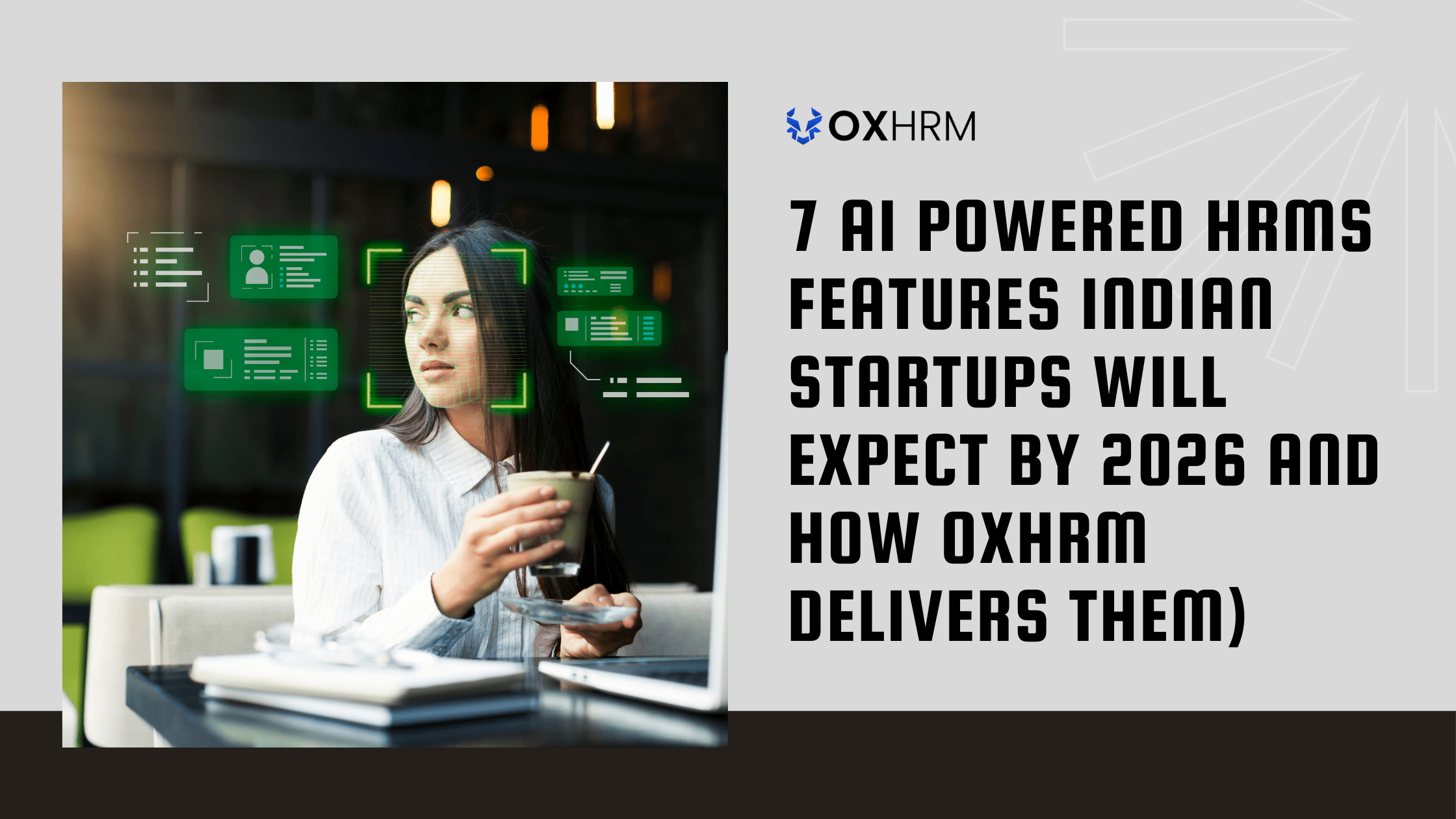
7 AI Powered HRMS Features Indian Startups Will Expect by 2026 And How OxHRM Delivers Them)
Why AI Features Are No Longer “Nice to Have”
By 2026, Indian startups and SMEs expect their HRMS to do far more than store data and run payroll. AI is now woven into everyday HR operations—speeding up hiring, answering employee questions instantly, and turning raw logs into clear, predictive insights about people and productivity. HR teams that still rely only on manual checks and spreadsheets are already at a disadvantage compared with those using AI enhanced systems.
1. AI Chatbot as a 24/7 HR Assistant
Employees now expect instant answers to simple HR questions—leave balance, policy clarifications, payslip downloads, and basic IT/HR how-to queries. Instead of tickets and email threads, an AI chatbot inside the HRMS can:
- Answer FAQs in natural language (leave rules, attendance doubts, reimbursement process).
- Guide employees step by step through common workflows (applying for leave, updating bank details).
- Reduce repetitive load on HR so they can focus on complex issues.
OxHRM can position its virtual assistant as the “first line of HR support,” embedded directly in the ESS portal and mobile app.
2. Smart, AIAssisted Onboarding Flows
Manual onboarding—scattered forms, ad-hoc checklists, and missed documents—hurts early employee experience. AI-augmented HRMS onboarding can:
- Auto-generate and route documents (offer letters, NDAs, policy acknowledgments).
- Trigger personalized task lists by role IT access, project assignments, training modules).
- Nudge managers and new hires with reminders if something is delayed.
OxHRM can frame this as “zero-chaos onboarding”: HR sets the rules once, and AI-driven workflows keep everyone on track.
3. Intelligent Time and Attendance Insights Not Just Logs)
Most tools record time; AI makes sense of it. With integrated desktop tracking, attendance, and project data, an AI-powered HRMS can:
- Spot unusual patterns (sudden late-login spikes, chronic overtime in one team).
- Suggest where policies or staffing need adjustment.
- Flag potential burnout or disengagement risks for proactive 11 talks, not just year-end surprises.
OxHRM already has the ingredients—time tracking, screenshots, projects—so the narrative becomes: “we donʼt just track hours, we highlight where leadership needs to look.”
4. Predictive HR Analytics for Capacity and Attrition
Founders and HR leaders increasingly want answers to “whatʼs coming next,” not just “what happened last month.” AI-powered analytics in an HRMS can:
- Forecast capacity shortfalls based on upcoming projects and historic effort.
- Flag likely attrition risks using patterns in attendance, engagement, and performance signals.
- Recommend hiring timelines and role mixes (senior vs junior) based on actual workload data.
OxHRM dashboards can be framed as “board-ready insights”—clear visuals on utilization, risk, and hiring needs that plug directly into planning and fundraising decks.
5. AI-Assisted Performance and Feedback
Traditional annual reviews are being replaced by continuous feedback and data-supported evaluation. An AI-enabled HRMS can:
- Aggregate signals from time, projects, peer feedback, and outcomes into a simple view.
- Suggest which goals or competencies to discuss in reviews based on recent work.
- Highlight top contributors who consistently deliver high-impact work but may be overlooked.
OxHRM can emphasize that AI should surface patterns, while managers still make the final human judgement—supporting fairer, more objective reviews.
6. Smart Policy and Compliance Guardrails
As regulations and internal policies evolve, HRMS platforms can use AI to:
- Auto-check entries (e.g., leave, overtime, shifts) against policy and flag violations before they become problems.
- Suggest corrections or options (e.g., convert excess hours to compensatory off, reclassify a leave type).
- Keep HR and finance aligned by spotting anomalies in payroll vs attendance vs contracts.
For OxHRM, this is a powerful angle: “policy-aware workflows” that quietly enforce rules in the background, instead of relying on HR to manually audit every exception.
7. Personalized Employee Experience in the ESS Portal
Just as consumer apps personalize feeds and recommendations, employees now expect HR systems to feel tailored, not generic. AI can help an HRMS:
- Personalize dashboards (showing the most relevant widgets: upcoming shifts, tasks, pending approvals, learning suggestions).
- Recommend content (policies, FAQs, training, benefits) based on role, tenure, or recent activity.
- Adapt notifications frequency and channels to employee behavior (who responds better on mobile, who needs email nudges).
OxHRM can brand this as a “smart home screen” for every employee—making the ESS portal feel less like a static intranet and more like a personal work hub.
Table of Contents

Shafeeq Khan is a web developer who creates modern, responsive, and user-friendly websites with clean code and creative design
Latest Posts
The 2031 Existential HR Guide: Managing the Psychological Transition to a Work-Optional World
Welcome to 2031. The decade-long transition that began with the "Great Resignation" and the "AI Revolution" has culminated in a...


The Rise of the Fractional C-Suite: Orchestrating Elite Talent Across Multiple DAOs in the 2030 Contribution Era
By 2030, the traditional "Corner Office" has been auctioned off as a historical artifact. The corporate landscape is no longer...
The 2030 Global Labor Protocol: Navigating the End of National Payroll and the Rise of Algorithmic Compliance
Remember 2024? Remember the frantic scramble at the end of every fiscal quarter? The endless back-and-forth with tax consultants over...