
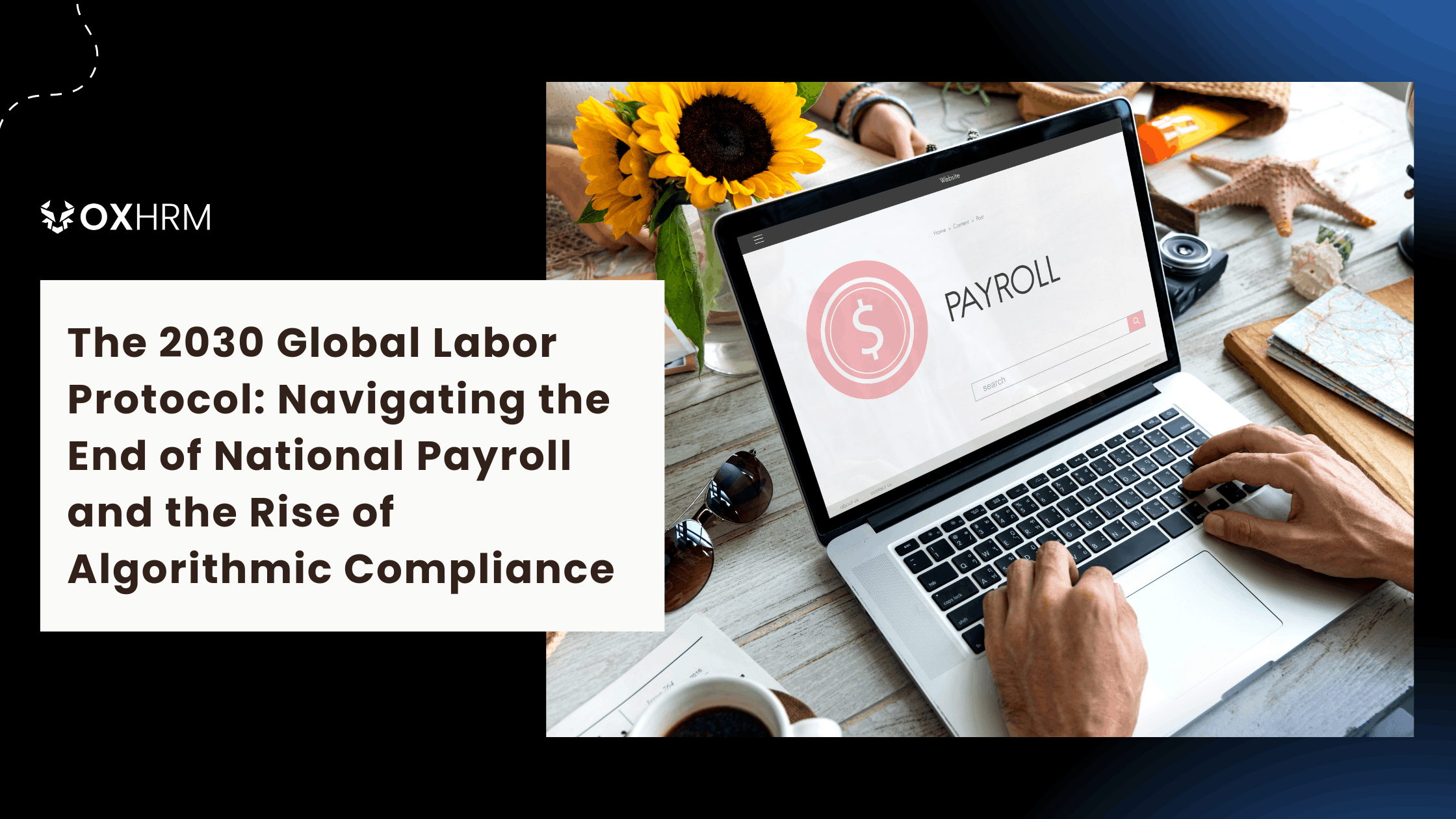
The 2030 Global Labor Protocol: Navigating the End of National Payroll and the Rise of Algorithmic Compliance
Remember 2024? Remember the frantic scramble at the end of every fiscal quarter? The endless back-and-forth with tax consultants over the US-India Double Taxation Avoidance Agreement (DTAA)? The manual filing of Form 16s, W-2s, and local Professional Tax registers? In the rearview mirror of 2030, those activities look like the labor of monks hand-copying manuscripts before the printing press.
We have entered the era of the Global Labor Protocol (GLP).
By 2030, the “Company Payroll Department” has effectively disappeared, replaced by a series of autonomous smart contracts. As the workforce has become almost entirely decentralized and mission-based, the old model of “Monthly Salaries” paid in “Local Fiat” by a “Local Entity” has collapsed. The GLP is the international API for human contribution. It is the friction-less layer that allows a developer in Jaipur, a designer in Berlin, and a bio-architect in Nairobi to “Sync-in” to the same mission and receive instant, compliant, and taxed compensation.
1. What is the GLP? The ISO 2030 Standard for Human Value
The Global Labor Protocol is not a piece of software; it is a Sovereign-Aggregated Standard. Think of it as the “TCP/IP of Work.” It was developed by a coalition of the G20 nations in 2028 to solve the “Tax Leakage” caused by the rise of DAOs and nomadic work.
A. The Three Layers of the Protocol
-
The Identity Layer: Built on self-sovereign identity (SSI). Your “Work Passport” contains your Reputation Score (Article 32) and your verified tax residency.
-
The Settlement Layer: Real-time “Streaming” of value. We no longer pay “once a month.” Money flows from the project’s treasury to the contributor’s wallet in micro-increments as tasks are verified by the AI-OR (Artificial Intelligence Orchestrator).
-
The Compliance Layer: This is where the local laws of the contributor’s physical location are encoded.
B. The Death of the “Payday”
In 2030, there is no “First of the Month.”
The Real-Time Payout Formula ($P_{rt}$):
$$P_{rt} = \int_{t_0}^{t_1} (V_{rate} \times \delta_{impact}) dt – (T_{local} + S_{social})$$Where $V_{rate}$ is the agreed value per unit of time/impact, $\delta$ is the quality multiplier, $T$ is the real-time tax deduction, and $S$ is the social security contribution.
2. Real-Time Tax-at-Source (TAS): No More Annual Filing
The most significant change in 2030 is that Tax Filing is Extinct. Because the GLP is linked to sovereign “Tax Nodes,” the government gets its cut the exact millisecond the worker gets theirs.
A. The “Sovereign Node” Logic
When a contributor “Syncs-in” to a mission via OXHRM, their digital identity broadcasts their current tax residency (validated by their GPS/Neural-ID).
-
The Split: The smart contract automatically splits the incoming payment. 70% goes to the worker, 25% to the “Home Node” (their place of residence), and 5% to the “Mission Node” (the jurisdiction where the company is legally registered).
-
The Result: Governments love the GLP because it has eliminated tax evasion. For the CHRO, this means zero liability for “Miscalculation.” The protocol is the auditor.
B. Solving the DTAA Maze
In 2024, if you worked in the UK for 4 months while being an Indian resident, you spent thousands on accountants to avoid being taxed twice. In 2030, the GLP handles the Double Taxation Avoidance logic algorithmically.
-
The “Nomadic Proration”: The protocol tracks your physical location and automatically adjusts the tax percentages to comply with the latest treaties, ensuring you are always taxed fairly and legally, regardless of where you are sitting.
3. The Portable Social Security Vault: Global Benefits for a Fluid Workforce
In 2030, “Health Insurance” and “Pension” are no longer “Company Perks.” They are Digital Assets that belong to the worker, funded by every mission they touch.
A. The “Universal Benefit Unit” (UBU)
Instead of a “PF Account” in India or a “401k” in the US, every worker has a Global Benefit Vault.
-
Micro-Accrual: Whether you work for 2 hours or 2 years for a DAO, a fraction of your payment is streamed into your Vault.
-
Portability: This Vault is independent of the employer. If you move from a project in Tokyo to a mission in Mumbai, your health insurance and pension accrual continue uninterrupted.
B. UBS (Universal Basic Services) Integration
In jurisdictions with UBS, the GLP serves as the “Eligibility Oracle.”
-
The Logic: If your “Reputation Score” and “Contribution History” meet certain thresholds, the protocol automatically unlocks premium tiers of public services (high-speed transport, advanced healthcare, neural-bandwidth) as a reward for your value-add to the global commons.
4. Algorithmic Labor Law: Code is the New HR Manual
By 2030, “Employment Contracts” are no longer 40-page PDFs. They are Code-Snippets executable on the GLP.
A. The “Right to Disconnect” (The Kill-Switch)
In 2026, we talked about “Policies” for disconnecting. In 2030, the GLP enforces it via the Neural-Link API.
-
The Protocol Enforced Rest: If a contributor has hit 32 hours of “High-Cognitive Load” in a week, the GLP triggers a “Compliance Lock.” The contributor can no longer access the project’s data stream until their “Biological Recovery” metrics are met. This protects the company from liability and the worker from burnout.
B. Dispute Resolution via Decentralized Arbitration
What happens if an AI-Orchestrator rejects a human’s work and refuses to pay?
-
The 2030 Jury: The dispute is sent to a decentralized pool of “High-Reputation Arbitrators” (Article 32). These are humans with specialized knowledge who review the case.
-
The Settlement: The protocol escrow holds the funds. Once the “Jury” votes, the smart contract settles the payment (or refund) instantly. No lawyers, no courts, no three-year waiting periods.
5. The “Fractional” Reality: Managing 50 Employers at Once
In 2030, the “Full-time Employee” is a rarity. 85% of the elite workforce is “Hyper-Fractional.”
A. The Cognitive Budget
How do you know if your top strategist is working for your rival simultaneously? In the 2030 GLP world, we don’t care about “Exclusivity”; we care about “Cognitive Allocation.”
-
The Transparency Ledger: OXHRM shows you that “Contributor X” has allocated 20% of their bandwidth to your mission. You pay for that 20%. The GLP ensures that they cannot “Double-Sell” the same cognitive hour to two different entities.
B. The “Skill-Tax” (Funding the Future)
A small percentage of every GLP transaction is funneled into a Global Upskilling Fund.
-
The Logic: As AI makes certain skills obsolete, the GLP uses these funds to provide “Bounties” for workers to learn new, high-demand skills. This ensures the global talent pool is always “Refreshable,” reducing the social cost of technological displacement.
6. Reputation-Based Lending: Your Work is Your Collateral
In 2030, you don’t go to a bank for a loan based on your “Salary Slip.” You get credit based on your GLP History.
-
The Reputation-to-Credit Ratio: Financial institutions plug into the GLP (with the worker’s consent) to see their “Consistency of Contribution” and “Peer Trust Score.”
-
The Smart-Loan: The loan is repaid through the GLP. A small fraction of every future “Contribution Stream” is automatically diverted to the lender until the debt is cleared. This has completely eliminated “Loan Defaults” in the 2030 economy.
7. Why OXHRM is the Sovereign-to-DAO Gateway
We built OXHRM to be the Translator between the old world of “Sovereign Laws” and the new world of “Global Protocols.”
-
GLP-Native Integration: One-click “Sync-in” for contributors anywhere in the world.
-
Real-Time TAS Engine: Automatically handles the complex math of 190+ sovereign tax nodes.
-
The “Silo” Security: Ensuring that while a worker is “Multi-missioning,” your proprietary IP is hermetically sealed within your project’s digital environment.
-
Reputation Verification: The definitive “Background Check” for the 2030 era—verified by blockchain, not by phone calls.
-
Nomadic Compliance: Tracking the worker’s “Digital Residency” to ensure 100% legal safety for the company.
8. Conclusion: The Borderless Boardroom
In 2030, the “Company” is no longer a place or a building. It is a Collaborative Frequency. The Global Labor Protocol is the tuning fork that ensures everyone is in sync.
As a CHRO or a business leader, your job is no longer to “Manage Payroll.” It is to Curate Contribution. The GLP has removed the administrative friction of borders, taxes, and currencies. What is left is the only thing that ever mattered: The Value of the Human Idea.
The world is your talent pool. The Protocol is your peace of mind.
2030 Global Labor Protocol Audit
-
[ ] Identity: Are we still using “Email/Phone” IDs or have we migrated to GLP-compliant SSI (Self-Sovereign Identity)?
-
[ ] Payments: Are we still on “Monthly Batches” or have we enabled “Real-time Value Streaming”?
-
[ ] Tax: Does our system integrate with the “Home Nodes” of our nomadic contributors?
-
[ ] Benefits: Are we contributing to “Portable Benefit Vaults” or stuck in legacy “Company Plans”?
-
[ ] Law: Is our dispute resolution “Court-based” or “Protocol-based”?
Table of Contents

Shafeeq Khan is a web developer who creates modern, responsive, and user-friendly websites with clean code and creative design
Latest Posts
The 2031 Existential HR Guide: Managing the Psychological Transition to a Work-Optional World
Welcome to 2031. The decade-long transition that began with the "Great Resignation" and the "AI Revolution" has culminated in a...


The Rise of the Fractional C-Suite: Orchestrating Elite Talent Across Multiple DAOs in the 2030 Contribution Era
By 2030, the traditional "Corner Office" has been auctioned off as a historical artifact. The corporate landscape is no longer...
The 2030 Organizational Psychology: Leading the “Volunteer” Workforce in the Age of Abundance
By May 2026, we were already seeing the cracks in traditional "Incentive Theory." By 2030, those cracks have become a...