
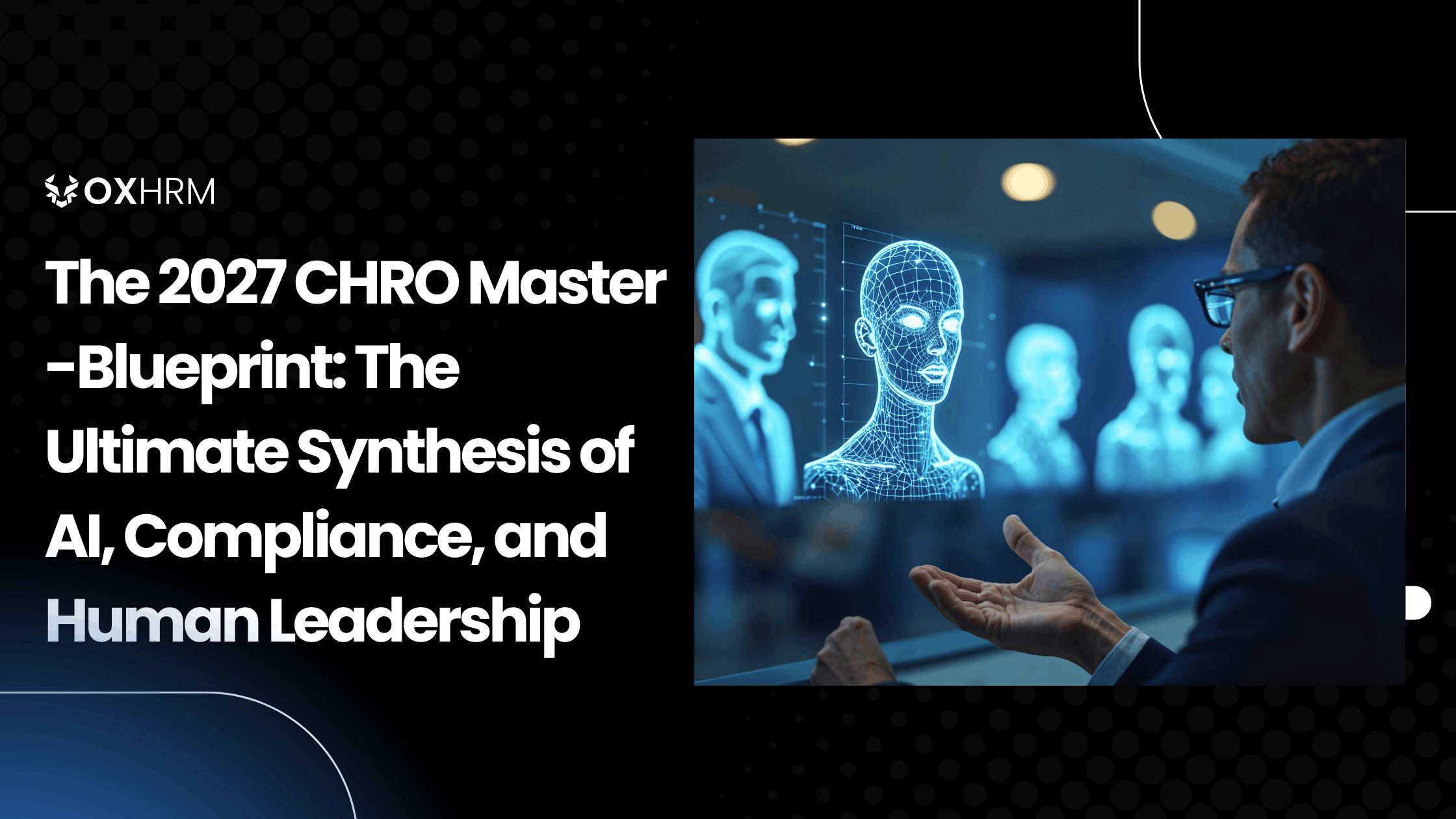
The 2027 CHRO Master-Blueprint: The Ultimate Synthesis of AI, Compliance, and Human Leadership
As we approach the twilight of 2026 and gaze into the horizon of 2027, the role of the Chief Human Resources Officer (CHRO) has undergone a permanent, irreversible metamorphosis. The era of “Administrative HR” is a historical footnote. Even the “Strategic HR” of the early 2020s feels quaint in the face of the current reality.
Today, the CHRO is the Chief Architect of Human-Digital Synergy. You are the custodian of the organization’s most valuable asset (people), the governor of its most powerful tool (AI), and the shield against its most significant risks (regulatory compliance).
1. The Architectural Shift: From Managing People to Orchestrating Talent
In 2027, the traditional “Org Chart” has been replaced by the “Workforce Orchestration Map.” We no longer view the company as a collection of departments; we view it as a fluid marketplace of Capabilities.
A. The Agentic Workforce
The defining shift of late 2026 was the transition from Generative AI (which creates content) to Agentic AI (which takes action). In your organization, AI Agents now handle 90% of scheduling, 80% of first-level support, and 70% of routine data analysis.
-
The Synergy Ratio ($S_r$): The core metric for the 2027 CHRO is no longer “Headcount Growth,” but the $S_r$.
$$S_r = \frac{Output_{Total}}{Total\_Human\_Hours}$$The goal of the 2027 blueprint is to increase the $S_r$ by empowering every human worker with a “Digital Co-pilot,” effectively turning a 500-person firm into a 2,000-person powerhouse.
B. The Skills-First Lattice
The “Linear Career Ladder” has collapsed. In its place is the “Career Lattice.”
-
Verified Skill Passports: Employees now own digital, blockchain-verified “Skill Passports.” Using OXHRM, the CHRO can see a real-time heatmap of the organization’s collective intelligence, allowing for “Just-in-Time” internal mobility.
2. The Regulatory Hegemony: Compliance as a Competitive Edge
In 2027, “Compliance” is no longer a checklist; it is the Foundation of Trust. The Indian regulatory landscape has reached a level of maturity that demands real-time, automated governance.
A. The DPDP Act 2027 Maturity
The Digital Personal Data Protection (DPDP) Act is now fully “Battle-Tested.”
-
Data Minimization by Default: The 2027 CHRO has implemented “Privacy by Design.” No data is collected unless it has a specific, AI-governed purpose.
-
The Right to Erasure: In 2027, an employee can trigger their “Right to be Forgotten” upon resignation. Your HRMS must be capable of a “Hard Wipe”—deleting all non-statutory data across the entire ecosystem instantly.
B. The New Wage Code: The Audited Reality
The ambiguity of 2025 is gone. The 50% Basic Pay rule and the universal definition of “Wages” are now strictly audited via the Unified Labor Portal.
-
Financial Liability Forecasting: The 2027 CHRO works in lockstep with the CFO. Using OXHRM’s Liability Engine, you provide a monthly report on the “Compounding Gratuity and PF Liability,” ensuring the balance sheet is always “Audit-Ready.”
3. The Empathy Economy: Leadership in a Post-Automation World
As AI handles the “Logic,” the human workforce must double down on “Empathy.” In 2027, the #1 rarest skill in the market is Emotional Intelligence (EQ).
A. The “Right to Disconnect” and Mental Resilience
With the lines between “Home” and “Work” permanently blurred by the distributed workforce (Article 12), the CHRO must act as the Guardian of Boundaries.
-
Technostress Monitoring: Using AI sentiment analysis, the 2027 CHRO monitors the “Digital Vibe” of the company. If the AI detects rising anxiety or “Always-On” behavior, it triggers a mandatory “Sync-Off” period.
-
Compassionate AI: We use AI to nudge managers toward empathy—reminding them of an employee’s work-anniversary, a recent high-stress project, or a “Burnout Risk” alert.
B. The Chief Ethics Officer
The 2027 CHRO is, by default, the Chief AI Ethics Officer.
-
Explainable AI (XAI): You must ensure that every AI-driven decision—from a hiring rejection to a performance score—is “Explainable.” The “Black Box” is the enemy of the 2027 culture.
4. The Financial CHRO: ROI, EBITDA, and Boardroom Influence
In 2027, the CHRO is the most influential person in the boardroom after the CEO. Why? Because you finally speak the language of Capital.
A. Measuring the ROI of Transformation
You no longer justify an HRMS purchase by “Improved Engagement.” You justify it by “Capital Efficiency.”
-
The “Fragmentation Tax” Recovery: As detailed in our ROI guide (Article 11), by consolidating 10 legacy tools into a unified OXHRM Ecosystem, the 2027 CHRO reclaims 15% of the total HR budget for reinvestment into R&D or talent bonuses.
B. The “Cost of Vacancy” Dashboard
The 2027 CHRO provides the Board with a real-time “Cost of Vacancy” report.
-
Formula:
$$Loss = \sum (LRPD \times D)$$Where $LRPD$ is Lost Revenue Per Day per empty seat and $D$ is the number of days the seat remains empty.
By reducing the “Time-to-Fill” via Recruitment 3.0, you are directly contributing to the company’s EBITDA.
5. The 2027 Strategic Roadmap: A 12-Month Execution Plan
To implement this Master-Blueprint, the CHRO must follow a rigorous, data-driven timeline.
| Quarter | Focus Area | Key Deliverable |
| Q1: The Cleanse | SaaS Consolidation | Sunset all redundant “Point Solutions”; migrate to a Unified Stack. |
| Q2: The Shield | DPDP & Wage Code Audit | Conduct a full “Data Protection Impact Assessment” (DPIA) and Salary Restructuring. |
| Q3: The Pulse | Agentic AI Integration | Deploy autonomous AI Agents for routine HR workflows (Leave, Claims, Support). |
| Q4: The Future | Skills-Based Re-Org | Transition to a “Lattice” model; implement the 2028 Predictive Budget. |
6. The 2027 CHRO Toolkit: Essential Capabilities
To survive and thrive, you must equip your department with the following four “Superpowers”:
-
Unified Data Sovereignty: A single “Source of Truth” that is compliant with Indian and global laws.
-
Predictive Analytics: The ability to see the “Flight Risk” and “Skills Gap” 6 months before they happen.
-
Mobile-First Inclusivity: Ensuring the “Last-Mile” field worker (Article 26) has the same experience as the C-Suite.
-
Instant Financial Liquidity: Offering Earned Wage Access (EWA) as a standard benefit to combat the cost-of-living crisis.
7. Conclusion: The Legacy of the 2027 CHRO
As we conclude this 30-article journey, remember this: Technology is the Skeleton, but Culture is the Heart.
The 2027 CHRO Master-Blueprint is not about building a “Cyborg Company.” It is about using the most advanced tools humanity has ever created—AI, Blockchain, Predictive Data—to make our organizations More Human.
It is about a world where:
-
Compliance is invisible and automatic.
-
Work is aligned with an individual’s deepest skills and passions.
-
Leadership is measured by empathy, equity, and impact.
The future of HR is no longer a distant vision; it is the platform you are building today. With OXHRM as your foundational operating system and this Blueprint as your guide, you are not just managing the future—you are creating it.
Final CHRO Checklist: The 2027 Ready-Test
-
[ ] Machine: Have we consolidated our tech stack into a single, AI-native ecosystem?
-
[ ] Shield: Is our data handling 100% compliant with the DPDP Act 2027?
-
[ ] Spirit: Do we have a measurable “Empathy Score” for our leadership team?
-
[ ] Money: Can we prove the exact EBITDA impact of our HR interventions this year?
-
[ ] Vision: Does our “Workforce Orchestration Map” include both Human and Digital workers?
Table of Contents

Shafeeq Khan is a web developer who creates modern, responsive, and user-friendly websites with clean code and creative design
Latest Posts

The 2031 Existential HR Guide: Managing the Psychological Transition to a Work-Optional World
Welcome to 2031. The decade-long transition that began with the "Great Resignation" and the "AI Revolution" has culminated in a...


The Rise of the Fractional C-Suite: Orchestrating Elite Talent Across Multiple DAOs in the 2030 Contribution Era
By 2030, the traditional "Corner Office" has been auctioned off as a historical artifact. The corporate landscape is no longer...

The 2030 Global Labor Protocol: Navigating the End of National Payroll and the Rise of Algorithmic Compliance
Remember 2024? Remember the frantic scramble at the end of every fiscal quarter? The endless back-and-forth with tax consultants over...