
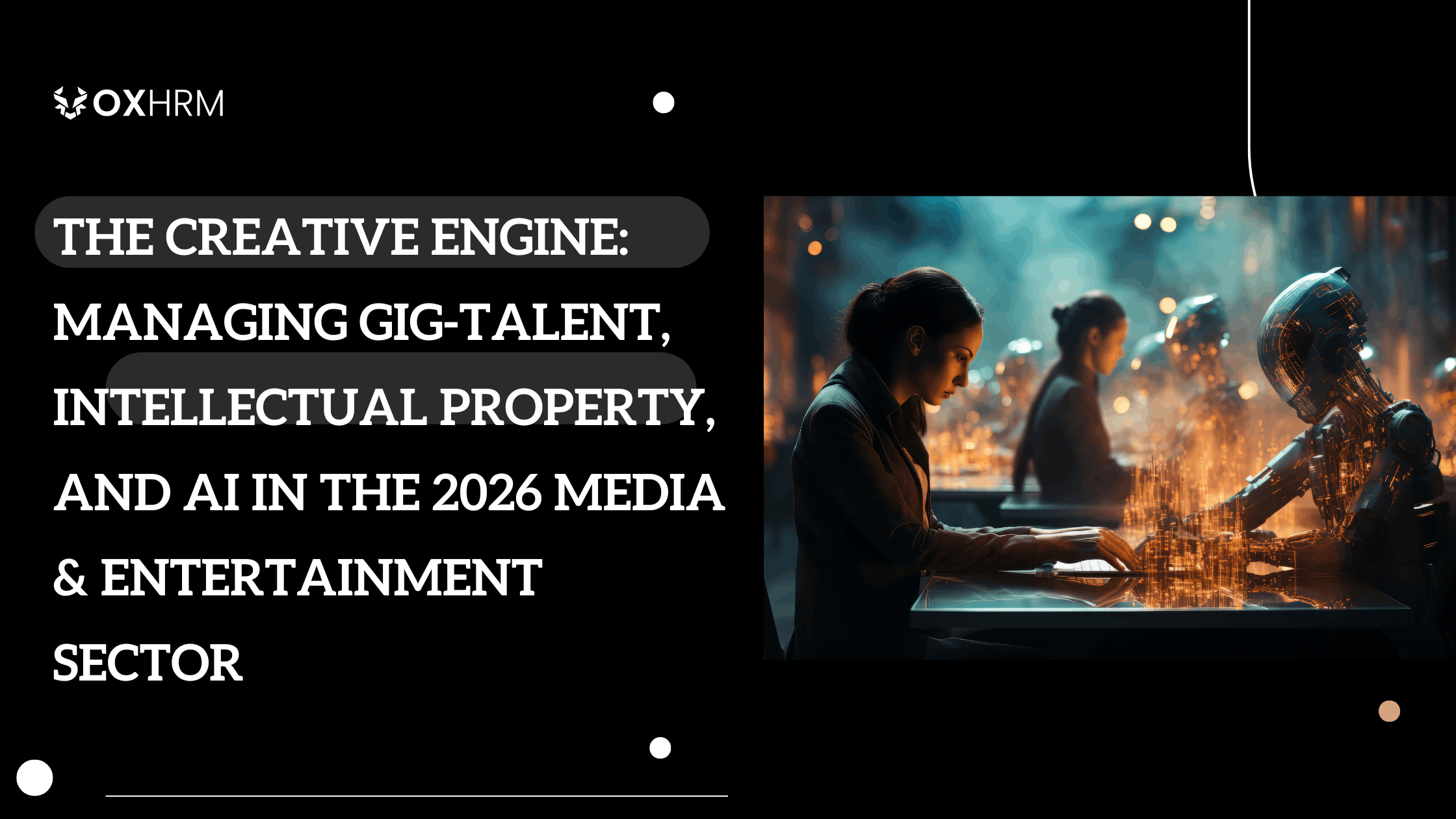
The Creative Engine: Managing Gig-Talent, Intellectual Property, and AI in the 2026 Media & Entertainment Sector
In 2024, the global entertainment industry was paralyzed by writers’ and actors’ strikes, fighting over the soul of creativity in the face of Artificial Intelligence. By the time we reach the mid-point of 2026, the dust has settled, and a new reality has emerged. The Indian Media & Entertainment (M&E) sector—spanning massive Bollywood studios, hyper-agile OTT production houses, Gaming companies, and VFX tech-hubs—has formalized its operations.
The era of informal “handshake deals” and undocumented crew management is officially over. Today, a production house is scrutinized with the same regulatory rigor as a manufacturing plant. With the Social Security Code 2026 classifying production houses as “Aggregators,” the DPDP Act enforcing strict script and talent data security, and the integration of Generative AI redefining what it means to be a “Creator,” the HR function has moved from the back office to the director’s chair.
1. The Generative AI Crisis: Coexistence, Credit, and Copyright
In 2026, AI does not replace the filmmaker, the animator, or the writer, but a creator using AI will absolutely replace one who doesn’t. HR’s primary challenge is managing the “Human-AI Creative Boundary.”
A. The AI Usage Policy & IP Ownership
If a concept artist uses an AI image generator to design a set, who owns the Intellectual Property? Under 2026 copyright interpretations, AI-generated work without “significant human alteration” cannot be copyrighted.
-
The HR Mandate: HR must enforce a strict “AI Disclosure Protocol.” Every gig-worker or full-time employee must log which AI tools were used in their workflow.
-
The “Clean IP” Vault: OXHRM integrates an “IP Disclosure Ledger” where VFX artists and writers mathematically quantify their human input (e.g., “70% human rendering, 30% AI upscaling”). This protects the studio from catastrophic copyright infringement lawsuits when selling the property to a platform like Netflix or Amazon.
B. The “Digital Twin” and Likeness Rights
In 2026, actors are licensing their “Digital Twins” (AI-generated likenesses and voice models) for background work or post-production dubbing (ADR).
-
Likeness Management: HR must manage complex “Likeness Contracts” that stipulate exactly how, when, and for how long a digital twin can be used. Using OXHRM’s Smart Contract Vault, if a studio attempts to use an actor’s digital voice for a sequel not covered in the original contract, the system flags the breach immediately to the legal team.
2. Managing the Gig-Crew: The Social Security Code 2026
A typical film or OTT series is a temporary corporation. It hires 500 people for three months and then dissolves. In 2026, managing this “Flash Workforce” requires unprecedented agility.
A. Production Houses as “Aggregators”
Under the Social Security Code, the spot boys, lightmen (gaffers), makeup artists, and junior artists are no longer “unorganized labor.”
-
The 1-2% Levy: The production house (or the platform) must contribute 1% to 2% of the total budget allocated to these gig-workers into the Central Social Security Fund.
-
UAN Verification on Set: You cannot let a crew member on set without a Universal Account Number (UAN). OXHRM’s mobile app allows the Line Producer to scan a worker’s Aadhaar at the studio gate, instantly syncing their UAN with the e-Shram portal and ensuring that the day’s wage includes the mandatory social security contribution.
B. Dynamic Geofenced Attendance for Locations
Shooting on location (e.g., a forest in Kerala or a street in London) makes attendance tracking a nightmare.
-
The Moving Geofence: OXHRM allows HR to create “Time-Bound Geofences.” If the shoot is at “Location A” on Monday and “Location B” on Tuesday, the system automatically shifts the permitted check-in zone. Crew members simply use facial recognition on their phones to clock in, ensuring accurate daily wage calculations without paper registers.
3. Project-Based Payroll and the Mathematics of “Residuals”
Standard monthly payroll does not work in the M&E industry. You are managing Upfront Fees, Milestone Payments, and long-term Royalties (Residuals).
A. The Milestone Payroll Engine
A scriptwriter might be paid 20% on the concept, 30% on the first draft, and 50% on the final shooting script.
-
Integration with Production Management: OXHRM integrates with tools like StudioBinder. When the Showrunner marks the “First Draft” as approved, OXHRM automatically triggers the 30% milestone payment to the writer’s bank account via API, eliminating payment delays that historically plagued the industry.
B. Calculating the “Streaming Residual”
In 2026, talent guilds have successfully negotiated “Success Metrics” for OTT streaming. If a show crosses 50 million views, the core cast and creators get a residual bonus.
The Residual Formula ($R_{pay}$):
$$R_{pay} = (V_{views} – B_{threshold}) \times C_{value} \times P_{equity}$$Where $V$ is total views, $B$ is the baseline threshold required for a bonus, $C$ is the contractual value per view, and $P$ is the talent’s equity percentage.
-
Automated Royalties: OXHRM’s payroll engine ingest viewership data from the streaming platform and automatically calculates and distributes these micro-royalties to the talent’s digital wallet, ensuring absolute financial transparency.
4. Security, DPDP Compliance, and “Leak” Prevention
In the media business, a leaked script or a leaked photo of a character’s new costume can cost millions in marketing impact.
A. The “Clean Room” Production Silo
Under the DPDP Act 2026 and severe Non-Disclosure Agreements (NDAs), project data must be hermetically sealed.
-
Role-Based Access: An editor working on “Project X” should have zero access to the HR directory or call sheets of “Project Y.” OXHRM uses Zero-Trust Architecture. If a freelancer’s contract ends on Friday at 6:00 PM, their access to the company Slack, the script vault, and the HR portal is automatically revoked at 6:01 PM.
B. Minor Talent Protection (DPDP Section 9)
The M&E industry employs thousands of children (child actors, reality show contestants).
-
Verifiable Parental Consent: As discussed in previous guides, collecting data on a minor requires strict consent. If a child actor is on set, their medical data (allergies, dietary requirements) and educational data must be stored in OXHRM’s Guardian Vault, accessible only by the Child Welfare Officer on set, and deleted immediately after the project concludes.
5. Burnout, OSH Code, and the “24/7 Shoots”
The glamor of the screen hides the grueling reality of a 16-hour shoot day. In 2026, the Occupational Safety, Health and Working Conditions (OSH) Code is strictly enforced on film sets.
A. Mandated Turnarounds and “Circadian Rest”
You can no longer force a crew to pack up at 3:00 AM and report back at 8:00 AM.
-
The 12-Hour Rest Rule: OXHRM’s AI Scheduler monitors “Wrap Times.” If a cameraman clocks out at 2:00 AM, the system blocks them from being scheduled for another call time until 2:00 PM the next day. If a producer attempts to override this, the system calculates and adds the “Penalty Overtime” to the budget automatically.
B. Intimacy Coordinators and POSH Compliance
The #MeToo movement fundamentally changed set dynamics. In 2026, POSH (Prevention of Sexual Harassment) compliance is highly digitized.
-
The Safe-Reporting Channel: Every crew member has access to an anonymous, encrypted grievance reporting tool within the OXHRM app. Furthermore, the system tracks the mandatory deployment of certified “Intimacy Coordinators” for relevant scenes, ensuring the studio is legally and ethically covered.
6. Union Compliance and Guild Management
The Indian media industry is heavily unionized (e.g., FWICE – Federation of Western India Cine Employees, SWA – Screenwriters Association). In 2026, union minimums and dispute resolutions are data-driven.
A. Automated Minimum Wage Adjustments
Union “Scale” (minimum daily wage) varies by role—a Focus Puller has a different scale than a Drone Operator.
-
The Union Master Data: OXHRM maintains a real-time database of the latest Union agreements. When a Line Producer builds the crew roster, the system automatically flags any day-rate that falls below the mandated union scale, preventing costly strikes or project shutdowns.
B. Earned Wage Access (EWA) for Junior Artists
Junior artists and background dancers often live paycheck-to-paycheck.
-
The Liquidity Fix: By implementing EWA, production houses allow these gig-workers to withdraw their daily wage immediately after their shift ends. In a highly competitive market, the studio that pays the fastest gets the best crew.
7. The Gaming & VFX Sector: Managing “Crunch Culture”
The Gaming and VFX industries operate differently from live-action shoots. They are highly technical and notorious for “Crunch”—months of extreme overtime leading up to a release date.
A. Predictive Burnout Analytics
“Crunch” destroys elite technical talent.
-
The Velocity Monitor: OXHRM integrates with Jira or ShotGrid. It tracks the “Render Load” and the hours logged by VFX artists. If the AI detects that an animation team has worked 70-hour weeks for three consecutive weeks, it issues a “Fatigue Red Alert” to the Creative Director, suggesting a deadline extension or a surge in freelance support before the team collapses.
B. Global Talent Mobility for Tech-Artists
VFX is a borderless industry. A studio in Mumbai might need an Unreal Engine expert from Canada for a 6-month stint.
-
Expats and Taxes: As detailed in our International HR guide (Article 28), OXHRM handles the Visa tracking, FRRO (Foreign Regional Registration Office) compliance, and the complex tax equalization required to manage high-end expat tech-artists in India.
8. Why OXHRM is the Showrunner’s Choice
We didn’t just build an HR tool; we built a Production Orchestration Engine.
-
Project-Based Architecture: Seamlessly switch between “Studio Operations” (Full-time staff) and “Project Operations” (Gig crews) within the same platform.
-
Milestone & Residual Payroll: Complex payout algorithms handled automatically, with full tax compliance.
-
DPDP “Clean Rooms”: Unbreakable data silos to protect your scripts, your casting data, and your unreleased IPs.
-
Mobile-First Set Management: QR-code attendance, digital call sheets, and EWA for the crew in the trenches.
-
Union-Ready: Pre-loaded with regional and national guild rules to keep your shoot legally uninterrupted.
9. Conclusion: Directing the Future of Creativity
In 2026, the content may be king, but the Creator is the Kingdom. The Media and Entertainment industry is transitioning from an era of exploitation to an era of Empowerment and Equity.
The production houses and studios that will dominate the late 2020s are those that treat their crew with the same respect they treat their star actors. By providing financial liquidity, ensuring physical and mental safety on set, and protecting the intellectual property of your teams, you don’t just manage a workforce—you build a loyal creative army.
Technology like OXHRM removes the chaos of the clipboard and the spreadsheet. It brings order to the art, allowing your visionaries to focus entirely on what they do best: Telling the stories that move the world.
2026 Entertainment HR Audit Checklist
-
[ ] Gig-Compliance: Are we contributing the 1-2% Social Security levy for our daily-wage crew?
-
[ ] AI Policy: Do we have an “IP Disclosure Ledger” for talent using Generative AI tools?
-
[ ] Set Safety: Does our scheduler automatically enforce the 12-hour rest rule between call times?
-
[ ] Data Privacy: Are our scripts, NDAs, and minor-actor data stored in a DPDP-compliant vault?
-
[ ] Payroll: Is our system capable of automating “Streaming Residuals” based on viewership data?
Table of Contents

Shafeeq Khan is a web developer who creates modern, responsive, and user-friendly websites with clean code and creative design
Latest Posts

The 2031 Existential HR Guide: Managing the Psychological Transition to a Work-Optional World
Welcome to 2031. The decade-long transition that began with the "Great Resignation" and the "AI Revolution" has culminated in a...


The Rise of the Fractional C-Suite: Orchestrating Elite Talent Across Multiple DAOs in the 2030 Contribution Era
By 2030, the traditional "Corner Office" has been auctioned off as a historical artifact. The corporate landscape is no longer...

The 2030 Global Labor Protocol: Navigating the End of National Payroll and the Rise of Algorithmic Compliance
Remember 2024? Remember the frantic scramble at the end of every fiscal quarter? The endless back-and-forth with tax consultants over...