
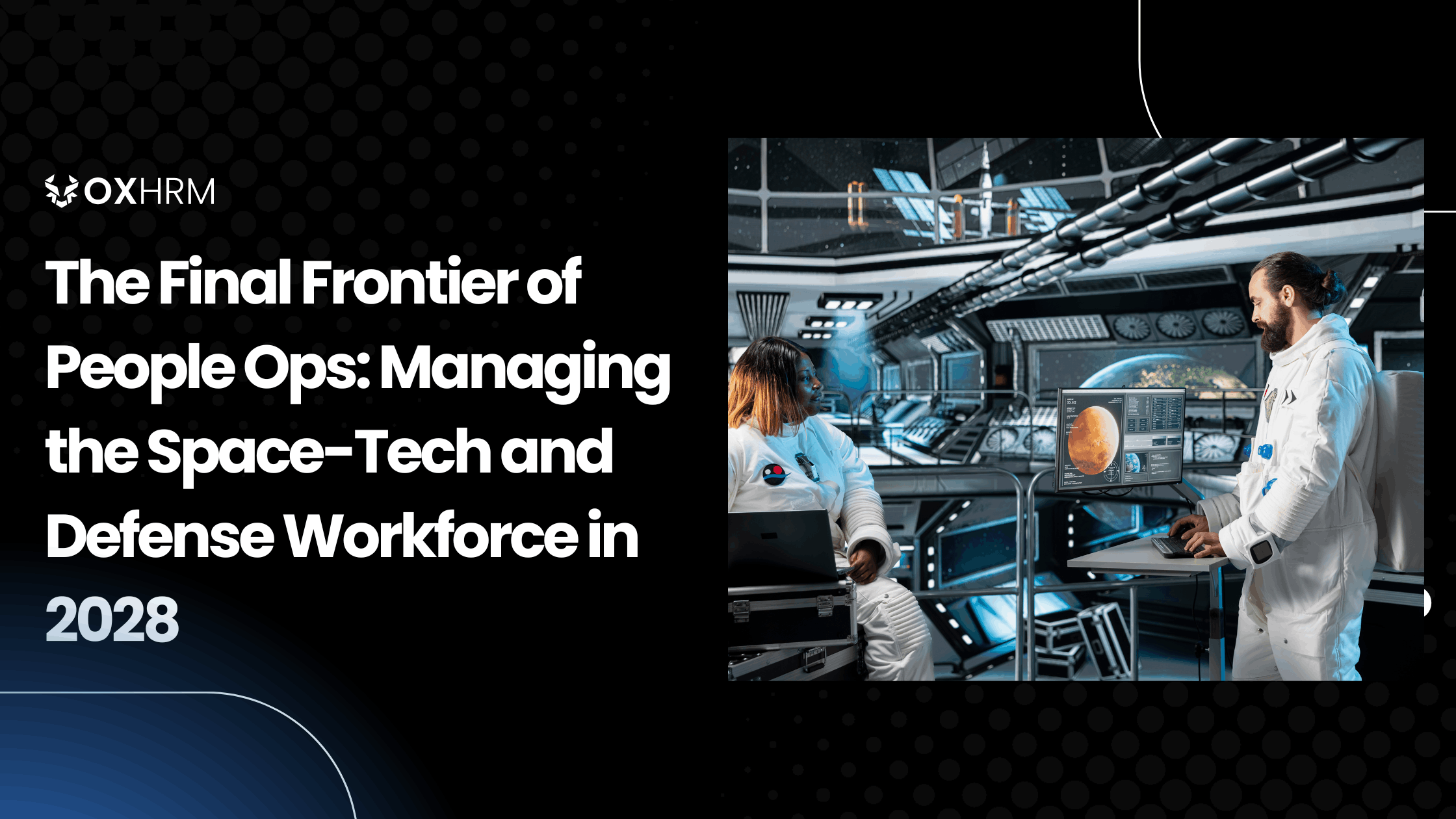
The Final Frontier of People Ops: Managing the Space-Tech and Defense Workforce in 2028
By January 2028, the “Space Economy” is no longer a speculative bubble—it is a $1.2 Trillion global reality. In India, the privatization of the space sector (boosted by the successes of ISRO and the IN-SPACe initiatives) has created a vibrant ecosystem of over 500 aerospace startups. Simultaneously, the global defense landscape has shifted toward “Hyper-Digital Warfare,” where AI-driven surveillance, cyber-defensive systems, and satellite constellations are the new front lines.
For the HR leader in 2028, the stakes are not just “Business Outcomes”—they are National Security and Mission Success. A single hiring error in a propulsion lab or a data breach in a defense software hub isn’t a “PR crisis”; it’s a threat to sovereignty.
1. Security Vetting 3.0: From “Snapshot” to “Continuous Assurance”
In 2024, a background check was a one-time event performed at the time of hiring. In 2028, for anyone handling “Classified” or “Dual-Use” technology, vetting is a Continuous, Real-Time Process.
A. Digital Identity and “Continuous Vetting” (CV)
Under the 2028 National Security Guidelines, employees in Defense and Space-Tech are subject to CV Protocols.
-
The Mechanism: Instead of five-year re-investigations, the HRMS (integrated with government security databases) monitors for “Red Flag Events” in real-time. This includes legal filings, sudden financial distress, or unauthorized foreign travel.
-
The HR Role: HR is no longer just the “Collector” of documents; you are the Risk Orchestrator. You must manage the delicate balance between security and privacy, ensuring that employees are supported during personal crises before they become security vulnerabilities.
B. Biometric and Behavioral Access
In high-security labs, “ID Cards” are obsolete.
-
Zero-Trust Identity: OXHRM integrates with Multimodal Biometrics (Iris, Gait, and Voice).
-
Anomalous Behavior Detection: If an engineer who usually accesses the satellite-bus schematics at 10:00 AM suddenly attempts to download the entire library at 2:00 AM on a Sunday, the system doesn’t just block them—it triggers an “HR Wellness Check” to see if the employee is under duress or external pressure.
2. The Niche Talent War: Recruiting the “1 in a Million”
In 2028, we are facing a global shortage of Propulsion Scientists, Avionics Architects, and Quantum Cryptographers. These individuals don’t “apply” for jobs; they are tracked from their second year of PhD.
A. The “Talent Observatory” Strategy
Space-Tech HR in 2028 acts like a scout for a professional sports league.
-
Predictive Sourcing: Using OXHRM’s Talent AI, firms track academic publications, patent filings, and GitHub contributions across the globe. We aren’t looking for “Aerospace Engineers”; we are looking for the person who solved a specific “Thermal Dissipation” problem in a research paper three years ago.
-
The “Golden Handcuffs” of 2028: Compensation for these roles is no longer just salary + ESOPs. It includes “Research Sovereignty”—guaranteed budgets for personal projects and access to state-of-the-art testing facilities.
B. Global Mobility vs. Sovereign Protection
How do you hire a German propulsion expert for an Indian defense firm without violating ITAR (International Traffic in Arms Regulations) or EAR (Export Administration Regulations)?
-
The Digital “Silo” Contract: In 2028, OXHRM manages “Siloed Employment.” The expat scientist works on a “Specific Module” with strict data-access barriers, ensuring they can contribute their expertise without ever seeing the “Sovereign Sensitive” parts of the project.
3. Mission-Critical Performance: Managing the “Launch Pressure”
In most industries, “Stress” is a buzzword. In Space-Tech, stress is a Biological Reality. The countdown to a rocket launch or a satellite deployment creates a high-cortisol environment that can lead to catastrophic human error.
A. The “Mission-Ready” Scorecard
We don’t use “Annual Appraisals” for launch crews. We use Daily Operational Readiness.
-
Cognitive Load Monitoring: Using wearable tech integrated with OXHRM, the system monitors the “Sleep Debt” and “Cognitive Fatigue” of mission-critical staff.
-
The “Redline” Protocol: If a Lead Flight Controller’s fatigue index exceeds a certain threshold, the CHRO has the authority (and the system-backed data) to mandate a “Tactical Swap,” moving a rested backup into the role.
B. Psychological Resilience Training
HR in 2028 provides “High-Stakes Simulation” Training.
-
VR Stress-Tests: Before a major mission, teams undergo VR simulations of “Total System Failure.” HR analyzes the team’s communication patterns and emotional regulation under pressure, providing “Micro-Coaching” to improve group cohesion.
4. Ethical AI in Defense: The HR Responsibility
The 2028 Defense sector is dominated by Lethal Autonomous Systems (LAWS) and AI-driven combat drones. This creates a profound ethical burden on the people who build them.
A. The “Moral Injury” Benefit
Engineers working on defense systems often face “Moral Injury”—psychological distress from the nature of their work.
-
HR Support: 2028 Defense HR provides specialized Ethical Counseling.
-
The “Right to Opt-Out”: Progressive defense firms allow engineers to “Opt-Out” of specific offensive-lethality projects and move to “Defensive/Cyber-Security” tracks without any career penalty, managed via the OXHRM “Preference Ledger.”
B. AI Governance Audits
HR must ensure that the “AI Ethics Board” is not just a rubber stamp.
-
Continuous Education: Every AI developer must undergo mandatory “Algorithmic Bias and Ethics” training every quarter, with the certification logged in their permanent employment record.
5. Compensation 2.0: Managing “Sovereign Incentives”
In 2028, the “Market Rate” for a Top-1% Space Engineer is effectively Infinite. How do you compete?
A. The “Sovereign Bonus”
In India, the government has introduced “Tax Holidays” for specialized talent working in identified “Sovereign Tech” sectors.
-
The Payroll Logic: OXHRM’s payroll engine automatically calculates these “National Interest Tax Rebates,” ensuring the employee sees a significantly higher “Take-Home” pay than they would in a standard commercial tech role.
B. Intellectual Property (IP) Royalties
If an engineer invents a new “Material Compound” that saves a satellite mission, they shouldn’t just get a “Pat on the Back.”
-
The Royalty Model: Modern Aerospace firms offer “Internal Royalty Streams.” For every commercial launch that uses that engineer’s specific patented component, they receive a micro-payout, tracked and disbursed through the OXHRM digital wallet.
6. The 2028 Space-Tech Workspace: The “Hybrid Mission Control”
You can’t “Work from Home” if you are building a satellite, but you can if you are coding its orbital maneuvers.
A. The “Clean-Room” Remote Protocol
For software engineers working on classified defense code from home:
-
Hardware Silos: The company provides “Hardened Terminals” with zero external connectivity.
-
Ambient Security: Using the OXHRM Security Plugin, the system uses the terminal’s camera for “Presence Verification” (ensuring no unauthorized person is looking at the screen) while maintaining strict DPDP privacy for the employee’s home environment.
B. “Mission-Sprints”
Instead of a 4-day week, Space-Tech uses “Cycle-Based Working.”
-
The Logic: Two weeks of “Intense Mission Preparation” (12-hour days, on-site) followed by one week of “Complete Asynchronous Recovery” (Remote, 4-hour days).
7. Compliance: ITAR, EAR, and the “Brain Drain” Guardrails
In 2028, “Trade Secrets” are the currency of power. HR is the Guardian of the Vault.
A. Automated ITAR Audits
Every interaction between an Indian engineer and a US partner must be logged for ITAR compliance.
-
The Solution: OXHRM automatically tags communication and data-exchange events with “Compliance Markers,” providing a real-time audit trail for the Ministry of Defense or international regulators.
B. “Non-Compete” in the Age of Sovereignty
While “Non-Competes” were banned in many commercial sectors in 2025, they have been Strengthened in Defense.
-
The Trade-off: In exchange for a 2-year “Cooling-Off Period” (where they cannot work for a foreign rival), the employee receives a “Garden Leave Stipend” equal to 80% of their salary, managed through the payroll engine.
8. Why OXHRM is the “Operating System” for the Space-Age
Space-Tech and Defense require an HRMS that is Faster than a Rocket and Stronger than a Tank.
-
Military-Grade Security: AES-512 encryption and sovereign-cloud hosting for 100% data residency.
-
Continuous Vetting Integration: Real-time links to national security and financial databases.
-
High-Frequency Performance Tracking: Monitoring cognitive load and mission-readiness, not just “KPIs.”
-
Complex IP/Royalty Management: Managing micro-payouts for patented innovations.
-
Multi-Jurisdictional Compliance: Automated ITAR/EAR and local defense-contract tracking.
9. Conclusion: Architects of the Future
In 2028, the CHRO of a Space-Tech or Defense firm is an Architect of Humanity’s Future. You are not just managing “Workers”; you are managing the collective intelligence that will take us to Mars and the collective security that will keep us safe on Earth.
The transition from “Business HR” to “Mission HR” is the ultimate challenge of our profession. It requires a blend of Uncompromising Security, Deep Empathy for High-Pressure Talent, and a Visionary Understanding of Technology.
The stars are the limit. Your HR strategy should be, too.
2028 Space-Tech & Defense HR Audit Checklist
-
[ ] Security: Is our vetting process “Continuous” or still based on outdated snapshots?
-
[ ] Readiness: Do we have a “Cognitive Fatigue” monitoring system for our launch/mission crews?
-
[ ] Ethics: Is there a clear, protected “Opt-Out” path for engineers on offensive-lethality projects?
-
[ ] IP: Are we incentivizing innovation with a “Royalty-based” compensation model?
-
[ ] Compliance: Can we produce an ITAR-compliant audit trail for international collaborations in 60 seconds?
Table of Contents

Shafeeq Khan is a web developer who creates modern, responsive, and user-friendly websites with clean code and creative design
Latest Posts

The 2031 Existential HR Guide: Managing the Psychological Transition to a Work-Optional World
Welcome to 2031. The decade-long transition that began with the "Great Resignation" and the "AI Revolution" has culminated in a...



The Rise of the Fractional C-Suite: Orchestrating Elite Talent Across Multiple DAOs in the 2030 Contribution Era
By 2030, the traditional "Corner Office" has been auctioned off as a historical artifact. The corporate landscape is no longer...

The 2030 Global Labor Protocol: Navigating the End of National Payroll and the Rise of Algorithmic Compliance
Remember 2024? Remember the frantic scramble at the end of every fiscal quarter? The endless back-and-forth with tax consultants over...