
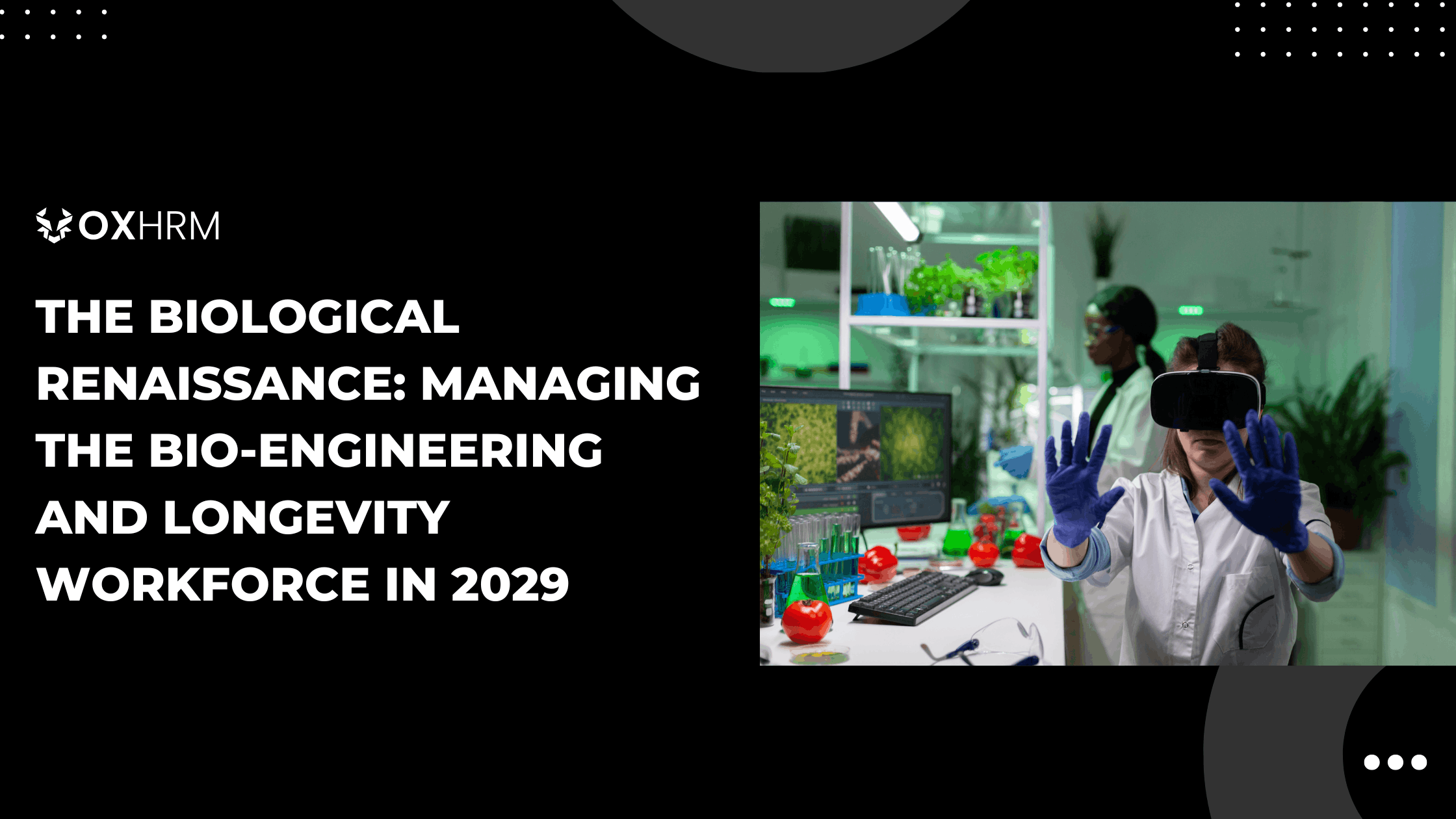
The Biological Renaissance: Managing the Bio-Engineering and Longevity Workforce in 2029
By 2029, the global healthcare landscape has undergone a tectonic shift. We have moved past the era of “General Medicine” into the era of Precision Bio-Optimization. The rise of CRISPR-Cas9 for therapeutic editing, the mass production of lab-grown organs, and the clinical validation of “Senolytic” (anti-aging) therapies have turned the human body into a programmable platform.
For the HR leader, this means the “Talent” you are managing is no longer just composed of doctors and nurses. You are now the custodian of Synthetic Biologists, Bioinformatics Orchestrators, Longevity Coaches, and Bio-Ethicists. Furthermore, with the passing of the DNA Data Protection Act (DDPA) 2029, managing employee biological data is now as legally sensitive as managing national security secrets.
1. The DDPA 2029: Navigating the DNA Data Protection Act
In 2024, we worried about Aadhaar leaks. In 2029, we worry about Genomic Leaks. The DNA Data Protection Act (DDPA) is the most stringent privacy law in human history, treating genetic code as the “Ultimate Personal Property.”
A. Genetic Sovereignty in the Workplace
Many bio-engineering firms require employees to work with sensitive genetic materials. In 2029, “Accidental Exposure” isn’t just an OSH (Occupational Safety and Health) issue; it’s a data privacy issue.
-
The “Genomic Firewall”: HR must ensure that an employee’s own genetic data (collected for health monitoring or security) is never “Co-mingled” with the company’s research data.
-
The Zero-Knowledge Vault: Using OXHRM, firms now use “Zero-Knowledge Proofs” for biological verification. You can verify that a lab technician is “Biologically Clear” to enter a high-pathogen zone without the company ever seeing their actual DNA sequence.
B. Preventing “Genetic Discrimination”
With longevity treatments becoming a corporate benefit, a new risk has emerged: the “Genetic Underclass.”
-
The Mandate: HR must strictly prevent any bias in hiring or promotion based on an employee’s “Projected Longevity” or “Genetic Predispositions.” The 2029 CHRO is the primary auditor of Algorithmic Fairness to ensure the AI doesn’t subconsciously filter for “Genetically Robust” candidates.
2. Recruitment for the “Bio-Architect” Era
We are no longer looking for people who can “operate” machines; we need people who can “code” life. The 2029 recruitment funnel is a hunt for Multi-Disciplinary Ph-Ds.
A. The Rise of the “Bio-Coder”
The most sought-after profile in 2029 is the person who understands both Python and Proteomics.
-
Sourcing the Synthetics: We use OXHRM’s Deep-Skill AI to scan global bio-repositories and open-source wet-lab contributions. We are looking for “Proof of Concept”—the person who successfully modeled a protein-folding solution that saved a clinical trial three years ago.
-
The “Wet-Lab” Simulation: Recruitment in 2029 involves VR-simulated CRISPR edits. Candidates are judged not on their “interview answers” but on their Precision, Ethical Speed, and Error-Correction Logic in a virtual laboratory.
B. Global Bio-Sovereignty and the “Brain Drain”
In 2029, countries treat their top bio-engineers like “Nuclear Assets.”
-
Bio-Visas: HR must navigate new “Strategic Talent Treaties.” Hiring a top-tier geneticist from a rival economic bloc now requires National Interest Clearances and specialized “Talent-Security” protocols managed via the OXHRM Compliance engine.
3. The Corporate “Bio-Stack”: Longevity as the Ultimate Benefit
In 2024, “Wellness” was a gym membership. In 2029, it is Biological Age Reversal. High-performance firms now offer the “Bio-Stack” as a standard part of executive and specialist compensation.
A. The Longevity Index ($L_i$)
We track the Biological Age ($A_b$) versus the Chronological Age ($A_c$) of our elite talent.
-
The Goal: A high $L_i$ indicates that the employee is “biologically younger” than their years, leading to higher cognitive endurance and lower healthcare costs.
-
The Benefit: Firms provide access to Senolytic therapies, NAD+ infusions, and personalized hyperbaric oxygen therapy. HR manages these as “Performance-Linked Benefits.”
B. Cognitive Longevity and the “Silver-Plus” Workforce
As discussed in our Silver Economy guide (Article 31), the 2029 workforce includes 75-year-olds with the cognitive vitality of 40-year-olds.
-
Phased Immortality: HR must design career paths that span 60 years instead of 35. This requires “Cyclical Upskilling”—every 10 years, the employee undergoes a “Biological and Professional Reset.”
4. Bio-Ethics: The HR “Moral Compass”
In a sector that can “Edit” life, HR is the Guardian of the Ethical Perimeter.
A. The “Designer Worker” Debate
In 2029, some employees may choose to undergo “Elective Enhancements” (e.g., neural interfaces or metabolic optimization).
-
The Policy: Should an “Enhanced” employee be promoted over a “Natural” one? HR must develop the 2029 Fairness Manifesto, which dictates that performance is measured by Outcome, not by the “Biological Method” used to achieve it.
B. Conscientious Objection in Bio-Tech
What happens if a scientist is asked to work on a project that violates their personal ethics (e.g., germline editing)?
-
The Safe-Exit Clause: OXHRM includes an “Ethical Preference Ledger.” An employee can “Red-Flag” certain research areas they are unwilling to touch. HR must ensure these employees are moved to different “Discovery Silos” without career regression.
5. Performance Management: Biological Real-Time Monitoring
In the 2029 high-stakes lab, “Burnout” isn’t a feeling; it’s a Biochemical State.
A. The “Metabolic Readiness” Dashboard
Using non-invasive sweat-sensors, the OXHRM Wellness Module monitors the “Cortisol-to-DHEA” ratio of mission-critical scientists.
-
The Intervention: If the AI detects a “Stress-Spike” that could lead to a laboratory error, it suggests a “Mandatory Metabolic Reset”—a 24-hour break combined with a personalized nutrition and sleep protocol.
B. Measuring “Cognitive Endurance”
In Bio-Engineering, the “Eureka” moment is rare. Performance is measured by Methodical Persistence.
-
The Metric: We track the “Hypothesis-to-Validation” velocity. How quickly can a scientist iterate through a failed experiment to find the “Winning Sequence”?
6. Compliance: The “Schedule M” Digital Evolution
The Indian government’s Revised Schedule M (Good Manufacturing Practices) has reached its 2029 peak. Compliance is now Autonomous.
A. The “Smart-Plant” HR Integration
In the 2029 Bio-Pharma plant, the building “knows” its people.
-
Credentialed Proximity: An employee cannot touch a bioreactor unless their “Digital Training Passport” in OXHRM is 100% current and they have passed the “Morning Bio-Health Check.”
-
The Autonomous Audit: Every action is logged on a private blockchain. If a quality breach occurs, the system traces it back to the specific “Human-Machine Interaction,” allowing HR to implement targeted “Retraining” rather than broad-stroke punishments.
7. Compensation 2.0: “Patent-Linked” Equity
In the Longevity sector, a single patent can be worth billions. “Salary” is an outdated concept for the people who invent these molecules.
A. The “Royalty-Path” Contract
Top Bio-Architects in 2029 demand Revenue Participation.
-
The Formula:
$$\text{Bonus} = \text{Base} + (\text{Market\_Success} \times \text{IP\_Contribution\_Index})$$ -
Automated Royalties: Using OXHRM’s Royalty Ledger, as the drug or therapy reaches market milestones, the system automatically calculates and disburses “Impact Bonuses” to the entire R&D team, ensuring long-term “Skin in the Game.”
8. Why OXHRM is the DNA of the Bio-Tech Era
We built OXHRM to handle the Precision of Science and the Complexity of Ethics.
-
DDPA-Compliant Vault: Military-grade encryption for biological and genetic employee data.
-
Ethical Preference Ledger: Managing “Conscientious Objections” in high-stakes research.
-
Bio-Ready Attendance: Integrating with biometric and health sensors for “Safe-Zone” access.
-
IP-Linked Payroll: Managing complex royalty and patent-participation payouts.
-
Global Bio-Visa Tracker: Navigating the “Sovereign Talent” regulations of 2029.
9. Conclusion: Guardians of the Human Code
In 2029, the Bio-Engineering and Longevity sector is the Vanguard of Human Progress. But progress without a “Human Heart” is dangerous. The CHRO in this sector is more than a manager; you are a Bio-Ethical Steward.
You are managing the people who will decide how long we live, how we heal, and what it means to be “Human.” By providing a framework of Uncompromising Privacy, Extreme Empathy, and High-Precision Analytics, you ensure that the quest for longevity is also a quest for Human Dignity.
The code of life is the most complex data set on earth. Let us help you manage the people who write it.
2029 Bio-Longevity HR Audit Checklist
-
[ ] Privacy: Is our employee data architecture 100% compliant with the DDPA 2029?
-
[ ] Ethics: Do we have a formal process for “Ethical Objection” without career penalty?
-
[ ] Talent: Are our recruitment simulations testing for Bio-Logic rather than just “Memory”?
-
[ ] Benefits: Is our “Bio-Stack” benefit equitable, or is it creating a “Genetic Hierarchy”?
-
[ ] Compliance: Can we produce an autonomous audit trail for our GXP (Good Practice) interactions?
Table of Contents

Shafeeq Khan is a web developer who creates modern, responsive, and user-friendly websites with clean code and creative design
Latest Posts

The 2031 Existential HR Guide: Managing the Psychological Transition to a Work-Optional World
Welcome to 2031. The decade-long transition that began with the "Great Resignation" and the "AI Revolution" has culminated in a...


The Rise of the Fractional C-Suite: Orchestrating Elite Talent Across Multiple DAOs in the 2030 Contribution Era
By 2030, the traditional "Corner Office" has been auctioned off as a historical artifact. The corporate landscape is no longer...

The 2030 Global Labor Protocol: Navigating the End of National Payroll and the Rise of Algorithmic Compliance
Remember 2024? Remember the frantic scramble at the end of every fiscal quarter? The endless back-and-forth with tax consultants over...